

The Problem with the "Open Container Law"

*DISCLAIMER: With this post, I am in NO way advocating for any illicit behavior or law-breaking. This is, solely, a discussion of how open-to-interpretation (and, difficult!) language can sometimes be."*
I remember studying abroad in Spain and seeing all the college students drink alcohol OUTSIDE OF THE BAR. What I’m saying is that they could drink on public streets. At least, that’s what it looked like, since that’s what they were doing. I was surprised because, where I’ve lived, that tended to be illegal.
So, if you’ve ever lived in the U.S. (and, I think the same goes for Jamaica), you’d know that, in most places, street drinking is a no-no. This rule is held in place through “the open-container law” which prohibits alcohol consumption and carrying open bottles of booze in a vehicle.
As an over analyzer of everything, I’ve thought about how “open-to-interpretation” the phrasing of this law might seem. Allow me to nerd out, just for a second. Please?
So, if we want to get deep into what this phrasing (“open bottle”) regulates, we must first look at the verb “to open”. If something’s “open”, it’s not closed, right? I’m sure some relevant loophole exists, but in regular conversation, “open” and “closed” are opposites.
This means that if I said that some nearby door is open, I’m implying that it isn’t closed. But one thing that isn’t made clear is how it got to be open. For instance, it could have blown open by a gust of wind, or a person could have physically pried it “un-shut”.
Whatever the case, this information wasn’t needed in my prior description. The sentence’s meaning was clearly understood. We really didn’t need to consider who or what did the opening. We’re merely pointing out that, right now, the door is in an open state. Any which way it occurred.
But what if we were to get technical?:
- “Zee opened the door.” —> Zee performed this action.
- “The door was opened by Zee.” —> Zee performed this action.
- “The door was opened.” —> It’s implied that someone or something did the opening, but the “who” or “what” isn’t mentioned. In other words, there’s understood to be an implicit “by” (the door was opened (by Zee or the by the wind)).
- “The door was open.” —> Who did it, isn’t the focus. We’re just commenting on the state the door was in.
Now that we’ve gotten that out of the way, let’s get back to open containers…
An open container is one that’s in an open state. It’s one that’s not closed, agreed? Whereas an opened container is one whose seal has been broken, whether or not the cap is currently on or off. Put differently, an opened container can be closed, in that the seal is broken, but the cap is currently screwed on.
Get it? If not, I’ve drawn a little diagram to explain this a bit better.
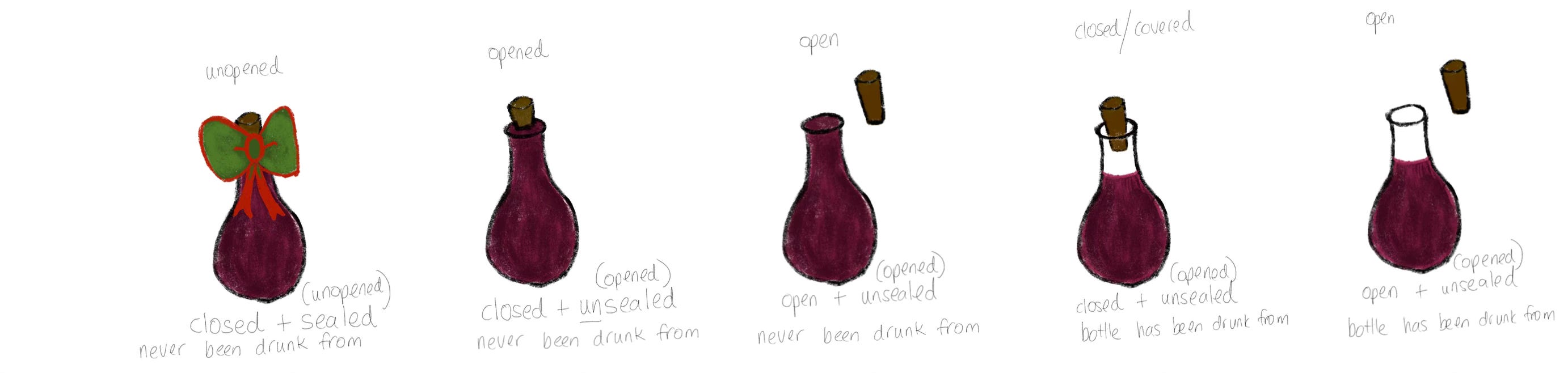
What I’m getting at, is that, if the law says no “open” containers, could one assume that you could, in fact, walk the streets or have stashed in your car’s trunk, a bottle that you previously drank from, but whose cap is now tightly clamped on? One that’s *now* closed.
Or, should it really be called the no opened container law—where you know right off the bat that if the seal was ever removed, uncapped, twisted off, or uncorked, that would count as breaking the law. Regardless of if the cap is now back on.
As we can see, It’s the interpretive aspect of law that helps keep the legal profession flourishing.
Language-ing is hard enough without the prejudice and discrimination we tack on to it. Why make life more difficult by adding on all that extra rigmarole?